We Turn Repairs into Decarbonization Tool
Fixit turns everyday repairs into measurable emissions reduction, without changing your processes.
We repair and refurbish consumer electronics in Vendors’ value chain and translate that activity into I-TEC Carbon Intensity Certificates. I-TECs can be applied directly to your carbon balance sheet.
Improve your reported Scope 3 performance without operational disruption or audit risk.


A Fixit Service
for Net‑Zero
Organisations across sectors have set ambitious Net‑Zero targets. For many, Scope 3 performance is now under scrutiny from investors, customers and regulators.
Scope 3 emissions are the largest and hardest to reduce.
Ambition alone is no longer enough.
Progress must be measurable and defensible.
Fixit converts repair and refurbishment already happening in the Vendor’s value chain into verified emissions reduction that can be accounted for.
What Is an I‑TEC?
I‑TECs (IT Asset Re‑use Certificates) are carbon intensity certificates created from repair and refurbishment activities inside Vendor’s value chain.
An I‑TEC is an innovative new low carbon intensity certificate issued by Fixit with Bloom ESG support.
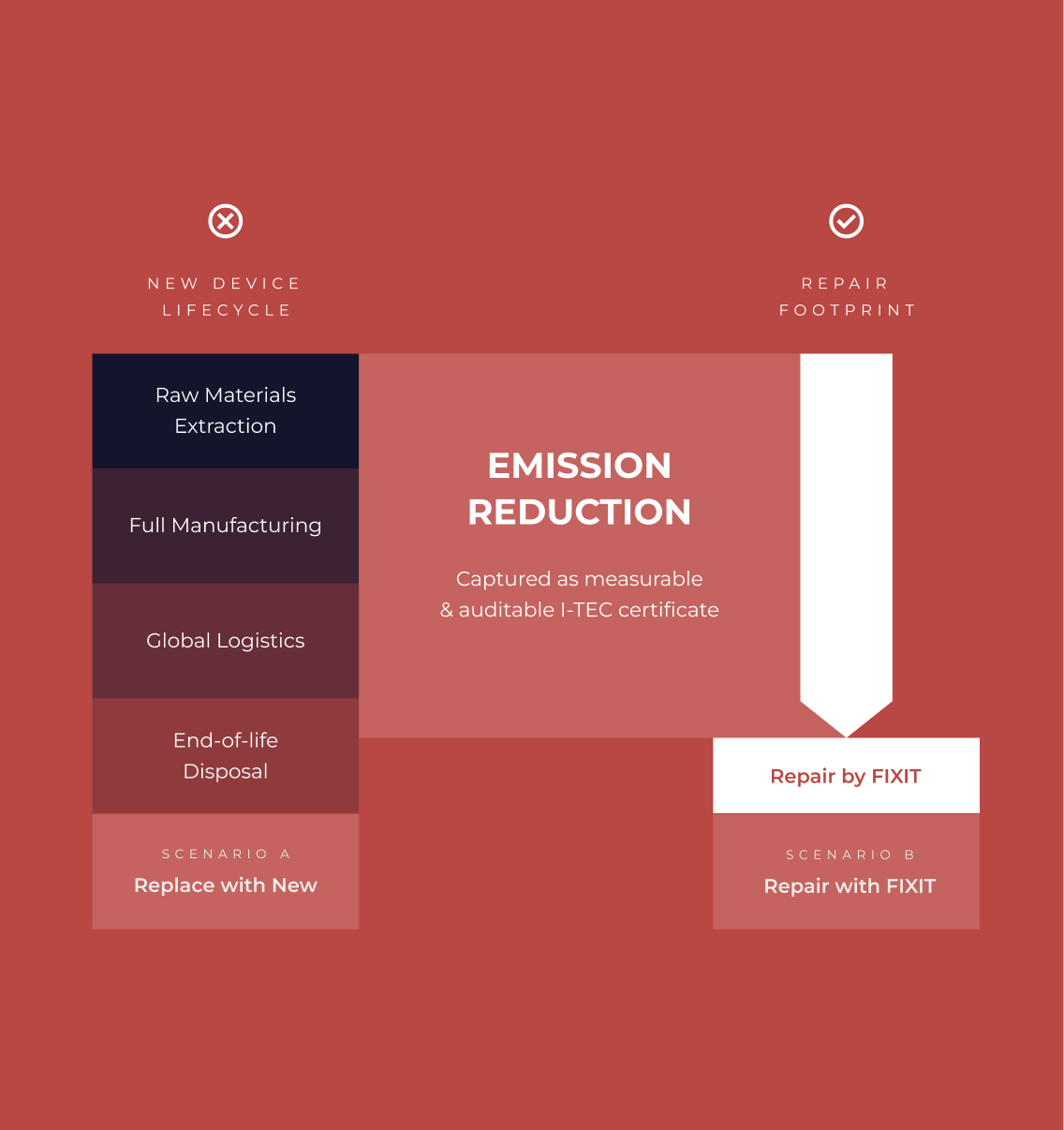
Each I‑TEC represents the verified, lower carbon intensity of a repaired or refurbished electronic device compared to a new product. It is based on real repair activity and the audited emissions profile of those processes, conducted at Fixit.
In simple terms:

We repair and refurbish products instead of providing replacement service

The measure lower emissions intensity, verified it and issued as an I‑TEC

That verified attribute can be applied to your Scope 3 carbon balance sheet


This works in a similar way to Renewable Energy Certificates (RECs)
Just as RECs separate the renewable attribute from the physical electricity and transfer it via a certificate, I‑TECs transfer the verified low‑carbon intensity of repair through a registry‑based, book‑and‑claim model.
Certificates are independently issued on Bloom ESG’s dedicated registry and can be retired with proof‑of‑retirement documentation to prevent double counting, in line with SBTi guidelines!
In electronics, a significant share of Scope 3 emissions is embedded in manufacturing new products
Repairing a device instead of replacing it avoids these manufacturing emissions, yet until now, this benefit has been difficult to capture in a way that is measurable, credible, and usable directly on the carbon balance sheet.
With Fixit you can:
- Accountable on the carbon balance sheet
- Independently audited (ISO-aligned)
- No double-counting
- Fixit assumes full responsibility for methodology and audit integrity
How It Works
Onboard
Join Fixit as your after sales processes operator.
Repair
We repair and refurbish devices in your value chain – extending product life and avoiding the need for new manufacturing.
Measure
We measure kilograms of devices processed – creating primary, activity-based data linked to real operations.
Verify
We calculate and verify carbon intensity (ISO‑aligned) – using product-level LCAs and independently reviewed methodology.
Certify
I‑TECs are issued and tracked in a registry – ensuring transparency, traceability and control.
Report
You apply the lower emissions intensity to your carbon balance sheet using a book‑and‑claim model – converting operational repair activity into reportable Scope 3 impact.
Who can use it?
Sustainability & ESG Teams
You are responsible for Net‑Zero targets, Scope 3 emissions, and credible climate reporting.
- Turn repair activity into a measurable Scope 3 reduction
- Apply verified, audit-ready emissions intensity to your carbon balance sheet
- Reduce reporting risk with an externally
verified methodology
This is value‑chain decarbonisation you can actually account for!
With Fixit owning the measurement, ISO compliance, and audit end‑to‑end.
Operations, After‑Sales & Repair Teams
You focus on repairing products, meeting service levels, and keeping customers satisfied.
- Keep existing repair processes unchanged
- Avoid changes to workflows or performance KPIs
- Generate additional environmental value from
existing operations
You keep
products in use.
You keep products in use. Fixit turns that work into emissions reduction.
Redefining decarbonization

Repairs become accountable emissions reduction
The work your team already does, can now be counted in Vendors’ climate targets, not just reported as activity.

Inside your value chain
The impact comes directly from servicing Vendors’ own products, not from buying external offsets.

No operational change
Vendors’ teams keeps the same repair workflows, tools and KPIs.

Risk transfer
Fixit takes responsibility for the methodology, calculations and audit process, so Vendors do not carry reporting risk.

Audited and fully managed
independently verified and aligned with ISO standards, so the results are credible at board and audit level.
Proven Impact
Depending on device type:

~50 kg CO₂e
larger consumer electronics

~2–50 kg CO₂e
per repaired device (average ~10 kg)

~2 kg CO₂e
small handheld devices
Strengthen your Scope 3 performance without changing how you operate
Contact Fixit to explore how Carbon Intensity Certificates can support your Net‑Zero and reporting strategy.
Contact usGlossary
Scope 3 emissions
Indirect emissions that occur across a company’s value chain, such as emissions from the production, use, repair, and end‑of‑life treatment of products. For most companies, Scope 3 represents the largest share of total emissions.
Carbon Intensity
The amount of greenhouse gas emissions associated with a unit of activity or product (for example, kilograms of CO₂e per kilogram of electronics processed).
Carbon Intensity Certificate
A certificate that represents a verified, lower emissions intensity of a product or activity compared to a conventional alternative. In this case, it reflects the lower carbon intensity of repaired and refurbished electronics compared to new products.
I‑TEC (IT Asset Re‑use Certificate)
A type of Carbon Intensity Certificate independently issued by Bloom ESG, from verified repair and refurbishment activities, representing the lower carbon intensity of reused electronics within the value chain.
SBTi (Science Based Targets initiative)
An international initiative that helps companies set emissions reduction targets aligned with climate science. Its latest guidance recognises the use of commodity‑style environmental attribute certificates within value‑chain decarbonisation.
Book‑and‑Claim
A system where the environmental benefit of an activity is recorded (“booked”) and transferred via a certificate (“claimed”), without requiring the physical product to move to a specific end user.
REC (Renewable Energy Certificate)
A certificate that represents the environmental attribute of one unit of renewable electricity. RECs are widely used as an analogy for how Carbon Intensity Certificates like I‑TECs work.
ISO 14064
An international standard for quantifying, monitoring, reporting, and verifying greenhouse gas emissions, used to ensure consistency and credibility in carbon accounting.